

mmcartalk
Expert
- Messages
- 4,164
- Reactions
- 2,677
MM Review: 2017 Hyundai Ioniq
A Review of the all-new 2017 Hyundai Ioniq
https://www.hyundaiusa.com/ioniq-hybrid/index.aspx
https://www.hyundaiusa.com/ioniq-electric/index.aspx
(Full-electric version only available in California)
IN A NUTSHELL: Ala Kia Niro, a Toyota Prius that doesn't look or feel like one.
CLOSEST AMERICAN-MARKET COMPETITORS: Kia Niro, Toyota Prius, Chevrolet Volt, Chevrolet Bolt, Ford C-Max, Ford Focus Electric, Honda Fit EV, Nissan Leaf, Volkswagen E-Golf




OVERVIEW:
Ever since the success of the original Hybrid gas / electric 2000 Toyota Prius in the American market (the smaller 2-seat Honda Insight Hybrid actually preceded it by several months, but was not successful), the pressure to convert the auto industry to alternative-fuel sources has been relentless...but not always constant. The Prius, over the years, has been an enormous hit with the Hollywood/celebrity-set, college professors, schoolteachers, environmentalists, and (let's face it)......with a lot of people who simply don't like cars, period, but sometimes have to drive further than is practical to wear out their legs and feet on bicycle, or put up with the noise of motorbikes. Though its sales have lessened somewhat lately, due to cheaper gas and the ever-increasing strength of SUVs (and Hybrid SUVs), the Prius has remained extremely popular....this, despite often-controversial body / styling, quirky interiors / controls, and unconventional driving characteristics / road manners. Styling, of course, is subjective, so I won't get into it to deeply here, excerpt to say that I'm not a fan of it, especially on the last two generations of the Prius.
Any car as successful as the Prius, of course, is bound to spawn some competitors. And, sure to form, as the number of Prius models themselves have multiplied into several different versions of both regular and long-range (Plug-in) models, so have the competitors from other companies also done so, both hybrid and full-electric, though, to date, an all-electric Prius still has not been introduced into the American market. And, with the introduction of the Kia Niro less than a year ago, the Koreans are now getting into the act with this type of vehicle. I did a review on the Niro some time ago, so I won't re-hash it much here. But now, Hyundai's version (done on the same platform) is also being introduced in the U.S....the Ioniq. Like the Niro, the Ioniq is styled far more conventionally than the Prius, inside and out....so, also like the Niro, previous owners of popular compacts like the Toyota Corolla and Chevy Cruze will feel more at home.
The Hybrid Ioniq, for the American market, comes in three basic versions......Blue ($22,200), SEL ($23,950), and Limited ($27,500). Full-Electric versions ($29,500 for the Base, and $32,500 for the Limited) are currently offered only in California, and, of course, I could not check them out or test-drive them here in the D.C. area. Legislation in California, of course, has long-favored electric and other alternate-fuel vehicles, and the state, unlike most others, has a well-developed grid/infrastructure for them. All Hybrid versions of the Ioniq are FWD, and use a 1.6L in-line gas-engine four of 104 HP / 109 ft-lbs. of torque, a permanent-magnet electric-drive motor of 43 HP / 25 ft-lbs. of torque (total system 139 HP), a 6-speed dual-clutch Shiftronic automatic transmission, and a Lithium-Ion polymer battery-pack. Full-Electric versions, likewise with FWD, use a Permanent Magnet Synchronous Motor of 118 HP / 218 ft-lbs. of torque and the Lithium-Ion battery-pack.
For the static-review, as usual, I checked out several versions of the Ioniq's interior and trim. For the test-drive, since the full-electric version is only available in California, it was obviously, here in the D.C. area, a choice of one of the gas/electric hybrid versions. I chose a 2017 SEL version with minimal options that listed for almost exactly $25,000....the 2018 models had not arrived at the dealership yet, but no major changes are planned for them.
MODEL REVIEWED: 2017 Hyundai Ioniq SEL
BASE PRICE: $23,950
OPTIONS: None
ACCESSORIES:
Bumper Applique: $70
Wheel Locks: $55
Cargo Net $50
DESTINATION/FREIGHT: $885 (not bad, but a little high for this size vehicle)
LIST PRICE AS REVIEWED: $25,010
DRIVETRAIN: FWD, Transversely-mounted 1.6L in-line gasoline 4, 104 HP @ 5700 RPM, Torque 109 Ft-lbs. @ 4000 RPM, 43 HP Permanent-Magnet electric -drive motor, Torque 125 ft-lbs., Total System 139 HP, 6-speed Shiftronic dual-clutch automatic transmission.
EPA MILEAGE RATINGS:
Blue: 57 City, 59 Highway, 58 Combined
SEL / Limited: 55 City, 54 Highway, 55 Combined
EXTERIOR COLOR: Black Noir Pearl
INTERIOR: Black Cloth
PLUSSES:
Phenominal (by American standards) EPA gas mileage ratings.
Butter-smooth, seamless drive train.
Relatively simple-layout interior controls.
Superb interior and exterior hardware.
A solid, quality feel to most of the structure.
Solid materials inside and out.
Excellent-quality paint jobs.
Excellent Hyundai/Kia 10/100 Drivetrain and 5/60 Bumper-to-Bumper warranties.
Lifetime warranties (from the factory) on Hybrid and Electric-drive batteries.
MINUSES:
Road noise on coarse surfaces.
Somewhat unresponsive handling by today's standards.
Sardine-can underhood layout.
Overly-firm seat padding typical of smaller Hyundai/Kia products. .
Rather dull-looking interior trim.
Manual hood prop-rod (though there isn't much you can actually DO under the hood).
Fix-a-Flat tire-inflator.
Cargo cover not available on most versions.
Only five available exterior paint colors.
EXTERIOR:
Although the Ioniq and its Kia Niro stablemate are done on the same platform (see my earlier review of the Niro), and are roughly the same size, sharing a 5-door hatchback design, the Ioniq is substantially different from the Niro both in general looks and overall styling theme. Where the Niro is more aggressive and sport-oriented in its styling, sporting a classic Kia Tiger-grille, the Ioniq is more laid-back and conventional, with an Audi-type grille and less-aggressive body lines overall. Both the Niro and Ioniq, of course, are substantially different in styling (in two different ways) from the market-leader Toyota Prius, whose styling, IMO, can best be compared to a Halloween mask. Like I said above, though, styling is subjective, and those are simply my impressions.....yours, of course, will be up to you.
As with most modern Hyundai/Kia products, very solid-feeling sheet metal and hardware is used (these vehicles really give you good value for your money in that department). In general, most new Kias, especially the smaller ones, feel even more solid than their Hyundai stablemates, but the Ioniq seems to be an exception. Almost everything on the outside of the Ioniq feels vault-solid, as does the loud but precise thunk you get when closing the doors and rear hatch. It does inside, too...but we'll get to that in a couple of minutes. Although the paint job is very well-done in its overall quality, a weak point is having only five colors to choose from....Black, white, gray, silver, and bright blue. At least all of the five colors are available in all three trim lines....some vehicles restrict lower-trim paint colors. The only thing on the exterior that I thought looked cheap (though it doesn't feel cheap) is the imitation brushed-metal look to the outside door handles that is used instead of the more-common black, body-color, or polished-chrome. But, overall, the exterior feels (almost) like it is carved out of granite.
UNDERHOOD:
Open the solid-feeling hood, and a nice but rather small underhood insulation-pad lies underneath. You must fumble with a manual prop-rod to hold it up, instead of nicer struts or springs. As with most smaller vehicles, it is fairly easy to reach and check fluids/dipsticks.reservoirs, but will be quite difficult, if not impossible, for most Do-it-Yourselfers to get much, if anything else, accomplished under the hood. The sideways (transversely)-mounted gas-engine four and the Hybrid electric-drive motor are both crammed in in quite tightly, the large black plastic engine cover covers most of the top-engine components, and there is little if any room to reach components down the sides. What little room the two engines, underhood, don't take up is pretty much taken up by other components. So, needless to say, almost everything under the hood will probably be best left to a Hybrid-qualified Hyundai or ASE-rated Technician.
INTERIOR:
Although the Ioniq and Niro look quite different on the outside in spite of sharing a common platform, inside, things are a little more in harmony between the two of them. The Niro has a distinct Audi-influence to the dash (perhaps not surprising since Kia's Lead Designer, Peter Schreyer, originally came from Audi), while the Ioniq is a little more traditional Korean in its look....both, of course, are far more conventional inside than the Prius. The Ioniq's interior, even in top-line Limited trim, is also a little less-ornate inside than the Niro'sgenerally busier look. As with the exterior, both use excellent hardware and switches inside, and the Ioniq's control-layout is generally simple and easy to use. The interior comes in a choice of Black or Black/Beige two-tone. I'd pick the two-tone, hands down, as, IMO, it makes the interior much less boring to look at than the standard black....again, as with the exterior, both interior choices seem to come with all three of the trim levels. Lower-line Blue and SEL trim levels come with cloth seats; Limiteds come with leather....yes, true leather, not imitation leatherette. Both the cloth and leather felt of high quality and well-constructed. As with many lower-line Kia and Hyundai products, I found the front seats a little too firmly-padded for my tastes, but the general shape and outline of the seats fit my large frame and torso quite comfortably. Overhead, the sun visors were large, thick, and solid, but made out of hard plastic. I also didn't care for the subdued, semi-gloss brushed-metal look of the interior door handles.....the same finish as that used on the exterior handles. Hyundai puts that semi-gloss door-handle look on a number of its products, not just the Ioniq. Headroom, up front, was OK for tall people my size (6' 2"), helped somewhat by a scallopped-out ceiling, but just barely adequate in back, with the somewhat sloping rear roofline. Legroom in back is about what is expected from a sedan/hatchback this size....for tall people, it's best to have the front seats moved up a little, especially when getting in and out. The droop-rear roofline does impact entry/exit a little for tall people, but not as bad as on some other smaller vehicles I've seen....and even on some not-so-small ones. The instrument display, in front of the steering wheel, is your typical Hybrid electronic analog/digital back-lit cluster in several different colors, with a circular speedometer and bar-graph hybrid-gauges for the different drive-modes and battery charge-levels. The stereo sound quality, overall, was not one of the better ones I've tried, but not bad for the price or this vehicle class.
CARGO COMPARTMENT/TRUNK:
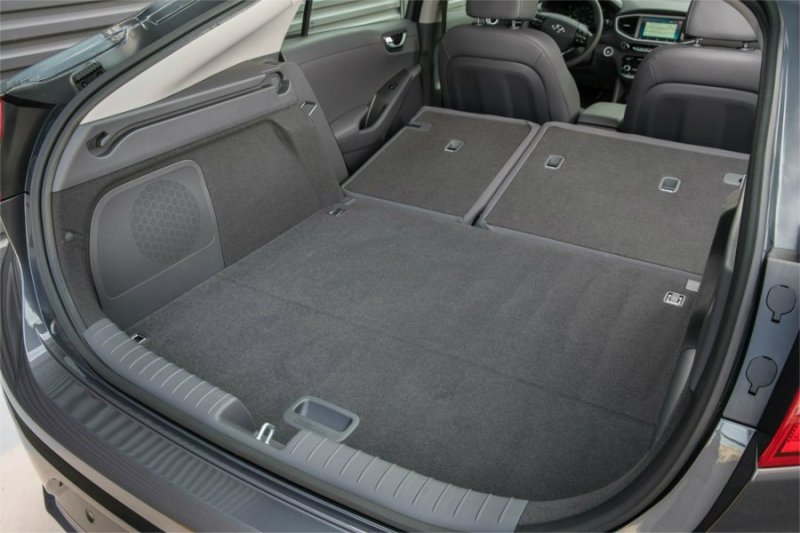
Open the rear hatch-lid (like the doors and hood, it has an extremely solid feel) and considering the slanted roofline and the space that the under-floor hybrid batteries take up, the cargo area is reasonably roomy, but not particularly well-finished. The 60/40 rear seats, of course, fold down to expand cargo space. A cargo net, cargo cover, and all-weather cargo tray are available as stand-alone accessories...my test-car lacked the cover. There is a thin fabric/carpeting on the center of the floor, and a non-carpeted surface on the walls and side of the floor. Under the trunk floor lies a tire-inflation kit (Fix-a-Flat)...there is no spare tire at all, although the car itself, unlike the Hankook or Kumho tires found on most smaller Korean-badged vehicles, comes with Michelin Energy Eco low-rolling resistance tires that are designed more for fuel-economy than for comfort or handling (more on that below).
ON THE ROAD:
Turn the ignition on with a push-button, and the hybrid drivetrain comes to life, lighting up the colorful analog/digital/electronic display in the gauge-panel. Unlike the quirky E-shifter in the Toyota Prius, the Ioniq uses a more traditional console-mounted lever with a conventional feel...fore and aft for the general gears, and back and to the left for automatic Sport (S) mode, and bump-up/down (+/-) for manual shifts. There is an Economy (Eco) drive-mode, which lights up with green lights, for even better gas economy, if one is willing to give up some acceleration. The drivetrain, of course, as with most hybrids, runs on either full-electric, full-gasoline, or a combination of the two as the computer determines from driving conditions, engine-load, coolant temperature, and battery-charge level. At low speeds in the Electric mode, it is, of course, almost dead quiet....you can faintly hear the gas engine engage when needed, but it is virtually seamless, and there are no noticeable bumps or surges. This is, of course, not a car for power-freaks, and the acceleration, even in the Sport drive mode, won't push you back in your seat, but there is adequate power for most normal driving situations unless the car is heavily loaded.
The Michelin Energy tires certainly do their share in the fuel-saving department (as noted by the EPA ratings for this car)..but, otherwise, lack a little in road manners. The rather hard rubber compound needed for low rolling-resistance and good gas mileage, along with less-than-ideal sound insulation from the open back end of the car, transmits road noise, especially on coarsely-paved surfaces. Some of that noise could probably be muted by the $150 cargo-cover option, which helps seal off the open cargo area (I'd say buy it...not only for noise-suppression, but for cargo security as well). Smooth, non-porous pavement also lowers the noise level some, but this is clearly not a luxury car on the road. In addition, the 36 PSI recommendation in the tires produces a rather firm (but not harsh) ride over most surfaces. It was a cold, blustery, windy day on the morning of the test-drive, with temperatures around freezing (not very comfortable outside), but the cabin-heating system worked well, and the crosswinds were not too intrusive in pushing the car off its tracking. Steering response is a little on the slow side compared to most sedans of this size, but still reasonably responsive. Body roll on cornering is low, as the suspension, along with the tires, is reasonably firm. Wind noise, unlike road noise, is quite well-muted....probably a result of the excellent materials and quality-control used in the vehicle's assembly. The regenerative brakes are quite unlike the touchy, overly-sensitive pedal found in many hybrid regenerative systems...in the Ioniq, the pedal actually has just a touch of softness/sponginess in the initial feel, then responding more or less normally. I didn't have any noticeable problems with my big size-15 clown-shoe in going from the gas to brake, or the shoe catching on the rim of the brake pedal.
THE VERDICT:
Folks, I'm not necessarily anti-Toyota (I try to be objective in my reviews)...but to he honest, I'd take this car, or its Kia Niro corporate brother (which I've also reviewed) over a Toyota Prius in a second, hands-down. It's (IMO) more sensibly-styled, built more solidly, uses better materials inside and out, drives as well or better (except for road noise), has just a seamless a hybrid power-train, has better-designed controls/switches, and seats that, though firmly-padded, are just as comfortable or better. Yes, the Prius has a solid reliability record, low depreciation, a long record of achievements in the past in the art of engineering hybrid drivetrains, and a long history of some parts of our society going Ga-Ga over it. In short, it is the cult-car of environmentalists...perhaps the ultimate anti-enthusiast vehicle. But, IMO,the Hyundai Ioniq and Kia Niro, today, produce what I consider to be a better, more practical, competition that has the added bonus of a solid thunk every time you shut the door and a solid, satisfying feel to its hardware and controls. And Hyundai and Kia give you a 10/100 warranty on the drivetrain (lifetime on the hybrid battery) and 5/60 on the rest of the car.....something the Prius lacks. No, the Ioniq is not a luxury vehicle (and I think its Kia Niro brother actually has a better interior)....but, if I were in the market for this class and type of vehicle, I certainly know where my money would go.
And, as always......Happy car-shopping.

MM
A Review of the all-new 2017 Hyundai Ioniq
https://www.hyundaiusa.com/ioniq-hybrid/index.aspx
https://www.hyundaiusa.com/ioniq-electric/index.aspx
(Full-electric version only available in California)
IN A NUTSHELL: Ala Kia Niro, a Toyota Prius that doesn't look or feel like one.
CLOSEST AMERICAN-MARKET COMPETITORS: Kia Niro, Toyota Prius, Chevrolet Volt, Chevrolet Bolt, Ford C-Max, Ford Focus Electric, Honda Fit EV, Nissan Leaf, Volkswagen E-Golf
OVERVIEW:
Ever since the success of the original Hybrid gas / electric 2000 Toyota Prius in the American market (the smaller 2-seat Honda Insight Hybrid actually preceded it by several months, but was not successful), the pressure to convert the auto industry to alternative-fuel sources has been relentless...but not always constant. The Prius, over the years, has been an enormous hit with the Hollywood/celebrity-set, college professors, schoolteachers, environmentalists, and (let's face it)......with a lot of people who simply don't like cars, period, but sometimes have to drive further than is practical to wear out their legs and feet on bicycle, or put up with the noise of motorbikes. Though its sales have lessened somewhat lately, due to cheaper gas and the ever-increasing strength of SUVs (and Hybrid SUVs), the Prius has remained extremely popular....this, despite often-controversial body / styling, quirky interiors / controls, and unconventional driving characteristics / road manners. Styling, of course, is subjective, so I won't get into it to deeply here, excerpt to say that I'm not a fan of it, especially on the last two generations of the Prius.
Any car as successful as the Prius, of course, is bound to spawn some competitors. And, sure to form, as the number of Prius models themselves have multiplied into several different versions of both regular and long-range (Plug-in) models, so have the competitors from other companies also done so, both hybrid and full-electric, though, to date, an all-electric Prius still has not been introduced into the American market. And, with the introduction of the Kia Niro less than a year ago, the Koreans are now getting into the act with this type of vehicle. I did a review on the Niro some time ago, so I won't re-hash it much here. But now, Hyundai's version (done on the same platform) is also being introduced in the U.S....the Ioniq. Like the Niro, the Ioniq is styled far more conventionally than the Prius, inside and out....so, also like the Niro, previous owners of popular compacts like the Toyota Corolla and Chevy Cruze will feel more at home.
The Hybrid Ioniq, for the American market, comes in three basic versions......Blue ($22,200), SEL ($23,950), and Limited ($27,500). Full-Electric versions ($29,500 for the Base, and $32,500 for the Limited) are currently offered only in California, and, of course, I could not check them out or test-drive them here in the D.C. area. Legislation in California, of course, has long-favored electric and other alternate-fuel vehicles, and the state, unlike most others, has a well-developed grid/infrastructure for them. All Hybrid versions of the Ioniq are FWD, and use a 1.6L in-line gas-engine four of 104 HP / 109 ft-lbs. of torque, a permanent-magnet electric-drive motor of 43 HP / 25 ft-lbs. of torque (total system 139 HP), a 6-speed dual-clutch Shiftronic automatic transmission, and a Lithium-Ion polymer battery-pack. Full-Electric versions, likewise with FWD, use a Permanent Magnet Synchronous Motor of 118 HP / 218 ft-lbs. of torque and the Lithium-Ion battery-pack.
For the static-review, as usual, I checked out several versions of the Ioniq's interior and trim. For the test-drive, since the full-electric version is only available in California, it was obviously, here in the D.C. area, a choice of one of the gas/electric hybrid versions. I chose a 2017 SEL version with minimal options that listed for almost exactly $25,000....the 2018 models had not arrived at the dealership yet, but no major changes are planned for them.
MODEL REVIEWED: 2017 Hyundai Ioniq SEL
BASE PRICE: $23,950
OPTIONS: None
ACCESSORIES:
Bumper Applique: $70
Wheel Locks: $55
Cargo Net $50
DESTINATION/FREIGHT: $885 (not bad, but a little high for this size vehicle)
LIST PRICE AS REVIEWED: $25,010
DRIVETRAIN: FWD, Transversely-mounted 1.6L in-line gasoline 4, 104 HP @ 5700 RPM, Torque 109 Ft-lbs. @ 4000 RPM, 43 HP Permanent-Magnet electric -drive motor, Torque 125 ft-lbs., Total System 139 HP, 6-speed Shiftronic dual-clutch automatic transmission.
EPA MILEAGE RATINGS:
Blue: 57 City, 59 Highway, 58 Combined
SEL / Limited: 55 City, 54 Highway, 55 Combined
EXTERIOR COLOR: Black Noir Pearl
INTERIOR: Black Cloth
PLUSSES:
Phenominal (by American standards) EPA gas mileage ratings.
Butter-smooth, seamless drive train.
Relatively simple-layout interior controls.
Superb interior and exterior hardware.
A solid, quality feel to most of the structure.
Solid materials inside and out.
Excellent-quality paint jobs.
Excellent Hyundai/Kia 10/100 Drivetrain and 5/60 Bumper-to-Bumper warranties.
Lifetime warranties (from the factory) on Hybrid and Electric-drive batteries.
MINUSES:
Road noise on coarse surfaces.
Somewhat unresponsive handling by today's standards.
Sardine-can underhood layout.
Overly-firm seat padding typical of smaller Hyundai/Kia products. .
Rather dull-looking interior trim.
Manual hood prop-rod (though there isn't much you can actually DO under the hood).
Fix-a-Flat tire-inflator.
Cargo cover not available on most versions.
Only five available exterior paint colors.
EXTERIOR:
Although the Ioniq and its Kia Niro stablemate are done on the same platform (see my earlier review of the Niro), and are roughly the same size, sharing a 5-door hatchback design, the Ioniq is substantially different from the Niro both in general looks and overall styling theme. Where the Niro is more aggressive and sport-oriented in its styling, sporting a classic Kia Tiger-grille, the Ioniq is more laid-back and conventional, with an Audi-type grille and less-aggressive body lines overall. Both the Niro and Ioniq, of course, are substantially different in styling (in two different ways) from the market-leader Toyota Prius, whose styling, IMO, can best be compared to a Halloween mask. Like I said above, though, styling is subjective, and those are simply my impressions.....yours, of course, will be up to you.
As with most modern Hyundai/Kia products, very solid-feeling sheet metal and hardware is used (these vehicles really give you good value for your money in that department). In general, most new Kias, especially the smaller ones, feel even more solid than their Hyundai stablemates, but the Ioniq seems to be an exception. Almost everything on the outside of the Ioniq feels vault-solid, as does the loud but precise thunk you get when closing the doors and rear hatch. It does inside, too...but we'll get to that in a couple of minutes. Although the paint job is very well-done in its overall quality, a weak point is having only five colors to choose from....Black, white, gray, silver, and bright blue. At least all of the five colors are available in all three trim lines....some vehicles restrict lower-trim paint colors. The only thing on the exterior that I thought looked cheap (though it doesn't feel cheap) is the imitation brushed-metal look to the outside door handles that is used instead of the more-common black, body-color, or polished-chrome. But, overall, the exterior feels (almost) like it is carved out of granite.
UNDERHOOD:
Open the solid-feeling hood, and a nice but rather small underhood insulation-pad lies underneath. You must fumble with a manual prop-rod to hold it up, instead of nicer struts or springs. As with most smaller vehicles, it is fairly easy to reach and check fluids/dipsticks.reservoirs, but will be quite difficult, if not impossible, for most Do-it-Yourselfers to get much, if anything else, accomplished under the hood. The sideways (transversely)-mounted gas-engine four and the Hybrid electric-drive motor are both crammed in in quite tightly, the large black plastic engine cover covers most of the top-engine components, and there is little if any room to reach components down the sides. What little room the two engines, underhood, don't take up is pretty much taken up by other components. So, needless to say, almost everything under the hood will probably be best left to a Hybrid-qualified Hyundai or ASE-rated Technician.
INTERIOR:
Although the Ioniq and Niro look quite different on the outside in spite of sharing a common platform, inside, things are a little more in harmony between the two of them. The Niro has a distinct Audi-influence to the dash (perhaps not surprising since Kia's Lead Designer, Peter Schreyer, originally came from Audi), while the Ioniq is a little more traditional Korean in its look....both, of course, are far more conventional inside than the Prius. The Ioniq's interior, even in top-line Limited trim, is also a little less-ornate inside than the Niro'sgenerally busier look. As with the exterior, both use excellent hardware and switches inside, and the Ioniq's control-layout is generally simple and easy to use. The interior comes in a choice of Black or Black/Beige two-tone. I'd pick the two-tone, hands down, as, IMO, it makes the interior much less boring to look at than the standard black....again, as with the exterior, both interior choices seem to come with all three of the trim levels. Lower-line Blue and SEL trim levels come with cloth seats; Limiteds come with leather....yes, true leather, not imitation leatherette. Both the cloth and leather felt of high quality and well-constructed. As with many lower-line Kia and Hyundai products, I found the front seats a little too firmly-padded for my tastes, but the general shape and outline of the seats fit my large frame and torso quite comfortably. Overhead, the sun visors were large, thick, and solid, but made out of hard plastic. I also didn't care for the subdued, semi-gloss brushed-metal look of the interior door handles.....the same finish as that used on the exterior handles. Hyundai puts that semi-gloss door-handle look on a number of its products, not just the Ioniq. Headroom, up front, was OK for tall people my size (6' 2"), helped somewhat by a scallopped-out ceiling, but just barely adequate in back, with the somewhat sloping rear roofline. Legroom in back is about what is expected from a sedan/hatchback this size....for tall people, it's best to have the front seats moved up a little, especially when getting in and out. The droop-rear roofline does impact entry/exit a little for tall people, but not as bad as on some other smaller vehicles I've seen....and even on some not-so-small ones. The instrument display, in front of the steering wheel, is your typical Hybrid electronic analog/digital back-lit cluster in several different colors, with a circular speedometer and bar-graph hybrid-gauges for the different drive-modes and battery charge-levels. The stereo sound quality, overall, was not one of the better ones I've tried, but not bad for the price or this vehicle class.
CARGO COMPARTMENT/TRUNK:
Open the rear hatch-lid (like the doors and hood, it has an extremely solid feel) and considering the slanted roofline and the space that the under-floor hybrid batteries take up, the cargo area is reasonably roomy, but not particularly well-finished. The 60/40 rear seats, of course, fold down to expand cargo space. A cargo net, cargo cover, and all-weather cargo tray are available as stand-alone accessories...my test-car lacked the cover. There is a thin fabric/carpeting on the center of the floor, and a non-carpeted surface on the walls and side of the floor. Under the trunk floor lies a tire-inflation kit (Fix-a-Flat)...there is no spare tire at all, although the car itself, unlike the Hankook or Kumho tires found on most smaller Korean-badged vehicles, comes with Michelin Energy Eco low-rolling resistance tires that are designed more for fuel-economy than for comfort or handling (more on that below).
ON THE ROAD:
Turn the ignition on with a push-button, and the hybrid drivetrain comes to life, lighting up the colorful analog/digital/electronic display in the gauge-panel. Unlike the quirky E-shifter in the Toyota Prius, the Ioniq uses a more traditional console-mounted lever with a conventional feel...fore and aft for the general gears, and back and to the left for automatic Sport (S) mode, and bump-up/down (+/-) for manual shifts. There is an Economy (Eco) drive-mode, which lights up with green lights, for even better gas economy, if one is willing to give up some acceleration. The drivetrain, of course, as with most hybrids, runs on either full-electric, full-gasoline, or a combination of the two as the computer determines from driving conditions, engine-load, coolant temperature, and battery-charge level. At low speeds in the Electric mode, it is, of course, almost dead quiet....you can faintly hear the gas engine engage when needed, but it is virtually seamless, and there are no noticeable bumps or surges. This is, of course, not a car for power-freaks, and the acceleration, even in the Sport drive mode, won't push you back in your seat, but there is adequate power for most normal driving situations unless the car is heavily loaded.
The Michelin Energy tires certainly do their share in the fuel-saving department (as noted by the EPA ratings for this car)..but, otherwise, lack a little in road manners. The rather hard rubber compound needed for low rolling-resistance and good gas mileage, along with less-than-ideal sound insulation from the open back end of the car, transmits road noise, especially on coarsely-paved surfaces. Some of that noise could probably be muted by the $150 cargo-cover option, which helps seal off the open cargo area (I'd say buy it...not only for noise-suppression, but for cargo security as well). Smooth, non-porous pavement also lowers the noise level some, but this is clearly not a luxury car on the road. In addition, the 36 PSI recommendation in the tires produces a rather firm (but not harsh) ride over most surfaces. It was a cold, blustery, windy day on the morning of the test-drive, with temperatures around freezing (not very comfortable outside), but the cabin-heating system worked well, and the crosswinds were not too intrusive in pushing the car off its tracking. Steering response is a little on the slow side compared to most sedans of this size, but still reasonably responsive. Body roll on cornering is low, as the suspension, along with the tires, is reasonably firm. Wind noise, unlike road noise, is quite well-muted....probably a result of the excellent materials and quality-control used in the vehicle's assembly. The regenerative brakes are quite unlike the touchy, overly-sensitive pedal found in many hybrid regenerative systems...in the Ioniq, the pedal actually has just a touch of softness/sponginess in the initial feel, then responding more or less normally. I didn't have any noticeable problems with my big size-15 clown-shoe in going from the gas to brake, or the shoe catching on the rim of the brake pedal.
THE VERDICT:
Folks, I'm not necessarily anti-Toyota (I try to be objective in my reviews)...but to he honest, I'd take this car, or its Kia Niro corporate brother (which I've also reviewed) over a Toyota Prius in a second, hands-down. It's (IMO) more sensibly-styled, built more solidly, uses better materials inside and out, drives as well or better (except for road noise), has just a seamless a hybrid power-train, has better-designed controls/switches, and seats that, though firmly-padded, are just as comfortable or better. Yes, the Prius has a solid reliability record, low depreciation, a long record of achievements in the past in the art of engineering hybrid drivetrains, and a long history of some parts of our society going Ga-Ga over it. In short, it is the cult-car of environmentalists...perhaps the ultimate anti-enthusiast vehicle. But, IMO,the Hyundai Ioniq and Kia Niro, today, produce what I consider to be a better, more practical, competition that has the added bonus of a solid thunk every time you shut the door and a solid, satisfying feel to its hardware and controls. And Hyundai and Kia give you a 10/100 warranty on the drivetrain (lifetime on the hybrid battery) and 5/60 on the rest of the car.....something the Prius lacks. No, the Ioniq is not a luxury vehicle (and I think its Kia Niro brother actually has a better interior)....but, if I were in the market for this class and type of vehicle, I certainly know where my money would go.
And, as always......Happy car-shopping.
MM
Last edited:


