

Gecko
Administrator
- Messages
- 5,146
- Reactions
- 12,661
Iconic sports cars fail to meet top IIHS crash-test standards
Car enthusiasts don't buy sports cars to stay in the slow lane. But given that the allure of higher speeds and bolder performance might lead to faster and more aggressive driving, they might think manufacturers have outfitted these cars with stringent safety protections.
That's not necessarily the case, according to the latest crash-test results from the Insurance Institute for Highway Safety. The organization, which conducts the most prominent crash tests in the industry, recently put America's three most iconic sports coupes through its full crash-test battery for the first time – and found none of them reached the organization's threshold for safety recognition.
The Ford Mustang, Chevrolet Camaro and Dodge Challenger all fell short of both Top Safety Pick+ and Top Safety Pick status, something that 65 other 2016 models achieved in prior testing. Released Tuesday morning, the results raise questions about the safety of motorists in cars they're prone to more risky driving behaviors.
"These vehicles have high horsepower and they're driven at higher speeds, and they'll crash at higher speeds," IIHS president Adrian Lund tells Autoblog. "So you'd like them to have strong protection, but none of them earned Top Safety Pick."
It can often be difficult for car shoppers to discern much difference from crash-test results. Ninety-nine percent of 2016 models tested under the federal government's program earn 4 or 5 stars, according to new data from the Center for Auto Safety. But in the IIHS' testing of muscle cars, stark differences emerge.
On the organization's small-front overlap test, which mimics the impact of the front quarter of the car with a fixed object like a parked vehicle or tree at 40 miles per hour, the Camaro was the only model to achieve a "good" ranking. The Mustang earned an "acceptable" mark and the Challenger had "marginal" performance. Researchers found extensive intrusion on the Challenger, and "limited survival space for the driver." Measurements taken on the crash-test dummy indicated a "high likelihood" of serious leg injuries (see photo below).

The dummy's left foot was entrapped and its ankle deformed. Technicians had to unbolt the dummy's foot from its leg to free it from the wreckage. That's only happened five other times in the organization's small-overlap testing history.
"When these vehicles go off the road in a single-car crash, it's often in a small-overlap configuration," Lund said, "so that's an important result." Forty-three percent of car-occupant deaths occurred in single-vehicle crashes in 2014, the latest year for which federal data is available.
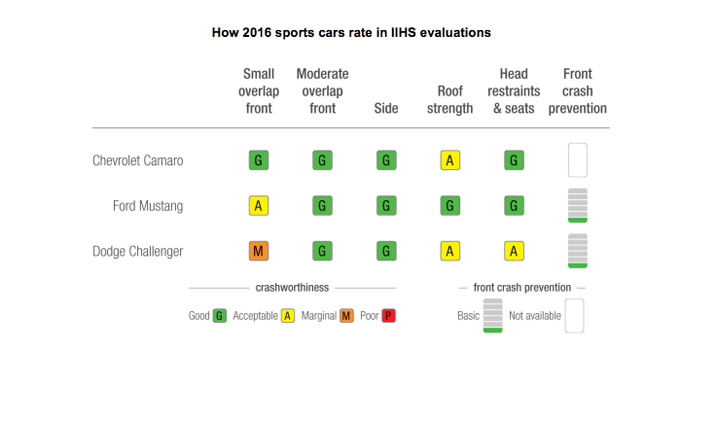
IIHS evaluated the three vehicles across all five of its crash tests as well as their crash-prevention systems. Overall, the Challenger was the worst-performing car of the group.
The Mustang came closest to achieving Top Safety Pick status, Lund said. Its small-front overlap rating holds it back, but otherwise it outperforms both its competitors in roof strength. Strong roofs are especially important for sports cars, which have among the highest driver death rates in single-vehicle rollovers, IIHS says.
Another differentiator: Both the Mustang and Challenger were equipped with basic crash-warning systems designed to alert drivers to imminent collisions. The Camaro was not equipped with any sort of crash-avoidance system.
"What we're seeing here is these vehicles are lagging behind on the crash-avoidance features that are being built into family-type cars," Lund said.
The results highlight another sore point for Detroit's Big Three manufacturers. When it comes to safety, they've fallen behind the competition. Of the 52 Top Safety Pick+ rankings awarded to 2016 models through January, only one has gone to a domestic vehicle. The Chrysler 200 – which FCA has since decided to discontinue – is the lone domestic recipient.
IIHS doesn't typically crash-test sports cars because they comprise a small overall share of the consumer market. But insurance data shows sports cars have the highest losses among passenger vehicles for crash damage repairs under collision coverage, according to the Highway Loss Data Institute. The three cars tested were all equipped with V-8 engines.
Source: http://www.autoblog.com/2016/05/24/iconic-sports-cars-fail-to-meet-top-iihs-crash-test-standards/
Car enthusiasts don't buy sports cars to stay in the slow lane. But given that the allure of higher speeds and bolder performance might lead to faster and more aggressive driving, they might think manufacturers have outfitted these cars with stringent safety protections.
That's not necessarily the case, according to the latest crash-test results from the Insurance Institute for Highway Safety. The organization, which conducts the most prominent crash tests in the industry, recently put America's three most iconic sports coupes through its full crash-test battery for the first time – and found none of them reached the organization's threshold for safety recognition.
The Ford Mustang, Chevrolet Camaro and Dodge Challenger all fell short of both Top Safety Pick+ and Top Safety Pick status, something that 65 other 2016 models achieved in prior testing. Released Tuesday morning, the results raise questions about the safety of motorists in cars they're prone to more risky driving behaviors.
"These vehicles have high horsepower and they're driven at higher speeds, and they'll crash at higher speeds," IIHS president Adrian Lund tells Autoblog. "So you'd like them to have strong protection, but none of them earned Top Safety Pick."
It can often be difficult for car shoppers to discern much difference from crash-test results. Ninety-nine percent of 2016 models tested under the federal government's program earn 4 or 5 stars, according to new data from the Center for Auto Safety. But in the IIHS' testing of muscle cars, stark differences emerge.
On the organization's small-front overlap test, which mimics the impact of the front quarter of the car with a fixed object like a parked vehicle or tree at 40 miles per hour, the Camaro was the only model to achieve a "good" ranking. The Mustang earned an "acceptable" mark and the Challenger had "marginal" performance. Researchers found extensive intrusion on the Challenger, and "limited survival space for the driver." Measurements taken on the crash-test dummy indicated a "high likelihood" of serious leg injuries (see photo below).
The dummy's left foot was entrapped and its ankle deformed. Technicians had to unbolt the dummy's foot from its leg to free it from the wreckage. That's only happened five other times in the organization's small-overlap testing history.
"When these vehicles go off the road in a single-car crash, it's often in a small-overlap configuration," Lund said, "so that's an important result." Forty-three percent of car-occupant deaths occurred in single-vehicle crashes in 2014, the latest year for which federal data is available.
IIHS evaluated the three vehicles across all five of its crash tests as well as their crash-prevention systems. Overall, the Challenger was the worst-performing car of the group.
The Mustang came closest to achieving Top Safety Pick status, Lund said. Its small-front overlap rating holds it back, but otherwise it outperforms both its competitors in roof strength. Strong roofs are especially important for sports cars, which have among the highest driver death rates in single-vehicle rollovers, IIHS says.
Another differentiator: Both the Mustang and Challenger were equipped with basic crash-warning systems designed to alert drivers to imminent collisions. The Camaro was not equipped with any sort of crash-avoidance system.
"What we're seeing here is these vehicles are lagging behind on the crash-avoidance features that are being built into family-type cars," Lund said.
The results highlight another sore point for Detroit's Big Three manufacturers. When it comes to safety, they've fallen behind the competition. Of the 52 Top Safety Pick+ rankings awarded to 2016 models through January, only one has gone to a domestic vehicle. The Chrysler 200 – which FCA has since decided to discontinue – is the lone domestic recipient.
IIHS doesn't typically crash-test sports cars because they comprise a small overall share of the consumer market. But insurance data shows sports cars have the highest losses among passenger vehicles for crash damage repairs under collision coverage, according to the Highway Loss Data Institute. The three cars tested were all equipped with V-8 engines.
Source: http://www.autoblog.com/2016/05/24/iconic-sports-cars-fail-to-meet-top-iihs-crash-test-standards/


